AI-Powered Predictive Analytics
By embracing AI-powered predictive analytics, government contract professionals can improve efficiency, reduce costs, and enhance overall contract performance.
By Hannelore Sammons-Ginger
 If you work in industry and have a contract lifecycle management (CLM) system, you may already use artificial intelligence (AI) to augment your contracting workflows. AI is not here to replace us; it is simply shaking up how we do business. (1)
Becoming AI literate is paramount for all contracting professionals as AI leaps into the foreground as the latest and greatest business tool. AI is the next revolution, and you can use it now to win more contracts and improve your performance as new opportunities emerge with AI-powered predictive analytics for contract management. (2)
As a business tool, we can now better leverage AI predictive analytics to enhance decision-making early in the contract lifecycle and boost overall speed and efficiency. (3) But what are we doing now? How have we tackled predictive analytics to date?
Predictive Analytics in the Past
Predictive analytics are not new. Since data scientists first defined the process, past data and statistics have been widely used to predict future trends. Every industry has a way of synthesizing this data into a sound output to help drive growth. From basic profitability metrics to analyzing stored information databases to defining trends, predicting the future for your organization can be key to organizational success and longevity. (4)
As machine learning methods and neural network capabilities emerged, the net for the application of predictive analytics widened. This allowed greater speed and depth of analysis to comb through data to find relevant patterns and insights.
A company could also hire consultants to analyze data and generate outputs, or an organization might use a CLMS to review proprietary data to find trends in performance and organize it into visualizations with ease.
Even outside your organization, you will likely interact with large database systems that extract information for various analytics. System for Award Management (SAM) and General Services Administration (GSA) eBuy hold opportunity and entity information, and the Federal Procurement Data System (FPDS) holds contract information. We can go to USAspending.gov and comb through contract data, filtering to find trends and patterns and using the past to predict the future.
Improving Decision-Making
AI can take vast sets of unstructured data and very quickly organize and find patterns in any data it ingests. So long as the data is accurate and relevant, the output will be insightful. We can now do in seconds what used to take weeks to prepare with a level of accuracy and reliability that did not exist before. This is the next leap in our ability to harness technology to augment daily business decision-making. AI can’t think for us, but it can help us to form better strategies and reduce risk. (5)
We can now analyze historical negotiation data to help our company start from a stronger position before we begin a negotiation. We can look at client behavior and historical data insights to be more competitive. We can also look back at historical contract performance data, which can help us navigate the future and make better decisions.
It can help coordinate contract renewals and predict them. It can analyze historical data, target client engagement levels, especially for high-value clients, and even begin to search for new opportunities. We can use machine learning tools to find patterns, decision trees, random forests, and neural networks to predict renewal likelihood.
AI natural language processing (NLP) can analyze contract language to find key terms, clauses, and deal-breakers. It can also pull from client communications to predict customer sentiment to gauge whether a customer is happy and likely to renew. AI can use data mining to find insights to determine what factors most affect the likelihood of renewal by looking at contract performance, client satisfaction, and market trends.
We can reduce risk, prevent disputes, delays, and overruns, and prevent some events before they happen. We can use resources more efficiently because AI can predict workload and needs to help allocate budget and people in a way that best supports the customer and the company.
Improving Speed and Efficiency
AI tools help automate routine, redundant tasks such as reporting, basic data entry, and contract review processes to save time and energy. AI can speed through vast amounts of data quickly and can augment how we process information to find answers to the questions that arise throughout the contract lifecycle since it can automatically extract data from various sources, such as PDFs, Word documents, and spreadsheets and populate it into vector databases.
For example, AI-powered predictive analytics can improve revenue forecasting and make accurate predictions, helping industry and agencies anticipate needs ahead of the curve.
AI-powered tools help draft and negotiate contracts by identifying potential clauses, risks, and opportunities. These tools can also monitor contract performance in real time, identifying deviations from the agreed-upon terms and conditions and catching problems faster.
AI can help monitor compliance with regulatory requirements in real time, enhancing transparency and accountability to detect anomalies and fraud. It can also automate and create more detailed audit trails to increase the ability of all parties to validate compliance.
AI offers various tools for data analysis, natural language processing, and predictive analytics. These benefits work together to speed up the contract lifecycle, save precious time and money, and achieve better outcomes.
Risks and Challenges
Adopting AI-powered analytic tools can introduce risks related to data rights and privacy, model accuracy, data quality, high costs, and regulatory compliance. Additionally, implementing these tools often requires substantial investments in infrastructure and training, posing a significant challenge for businesses to balance benefits with the costs and complexities involved.
Data Rights and Privacy
Companies must be vigilant in the AI adoption process to thoroughly examine the terms and conditions of any vendor agreement. Transparency in how the data is protected and how it may be used in the future is critical. Consulting with legal professionals specializing in information privacy and security, AI, and data governance is a smart step for any AI implementation strategy.
Breaches and unauthorized access events are a genuine concern with AI-powered tools. (6) The vast data that the AI ingests requires robust data security and infrastructure. It is also important to note that AI can easily strip data anonymization protections, so it is essential to know precisely how AI-ingested data will be processed and used now and in the future. One approach to mitigate this risk is to create smaller, proprietary AI tools that can be easier to secure and control than LLM Generative AI tools, but this can also have drawbacks.
Model Accuracy and Data Quality
AI hallucinates. It sometimes reaches conclusions that are flat-out wrong, omits information, or struggles with biases that affect outputs (such as when an AI tool used for human resources candidate screening decided that the most desirable applicants correlated to being named Jared and playing lacrosse in high school). (7)
AI is designed to find an answer for the user, but sometimes it finds the wrong one. Higher-quality AI solutions are designed to respond by stating that they cannot answer a prompt if they cannot meet a certain threshold of accuracy. However, a human tester will always be needed in the loop to review the AI output for accuracy and soundness. Maintaining high-quality datasets and prompt engineering is the best way to increase accuracy and reduce hallucinations.
High Initial and Integration Costs
AI requires increased computing power and equipment. Whether you are building a proprietary tool in-house or licensing a tool, the cost to adopt and integrate is high, as with any emerging technology. Training individuals to work with the new tool is also necessary, and skill gaps can be costly. There are also issues with older tools not integrating well with newer, AI-powered tools. So, the process can be more prolonged and arduous for companies and agencies trying to implement these new technologies.
Regulatory and Compliance Issues
The Federal Acquisition Regulation (FAR) limits how technology can be used in the procurement lifecycle. (8) Contractors can now use AI-powered tools in contract management to comply with FAR and Defense Federal Acquisition Regulation Supplement (DFARS) clauses in real time, and companies can use AI tools to track project milestones, funds, timekeeping, and labor cost reporting.
This can, in turn, create the need for continuous monitoring to generate audit trails for compliance. The government is moving to more stringent cybersecurity standards with Cybersecurity Maturity Model Certification (CMMC) and National Institute of Standards and Technology (NIST) SP 800-171.
Defense contractors must have clear policies on adopting AI tools and resources while maintaining cybersecurity compliance and meeting certification requirements. Using AI across all these business functions will allow excellent data capture to drive analytics beyond exporting reports to extrapolate insights. Companies can now use AI to ingest this data and make accurate predictions for how to improve performance in the future.
AI-Powered Use Cases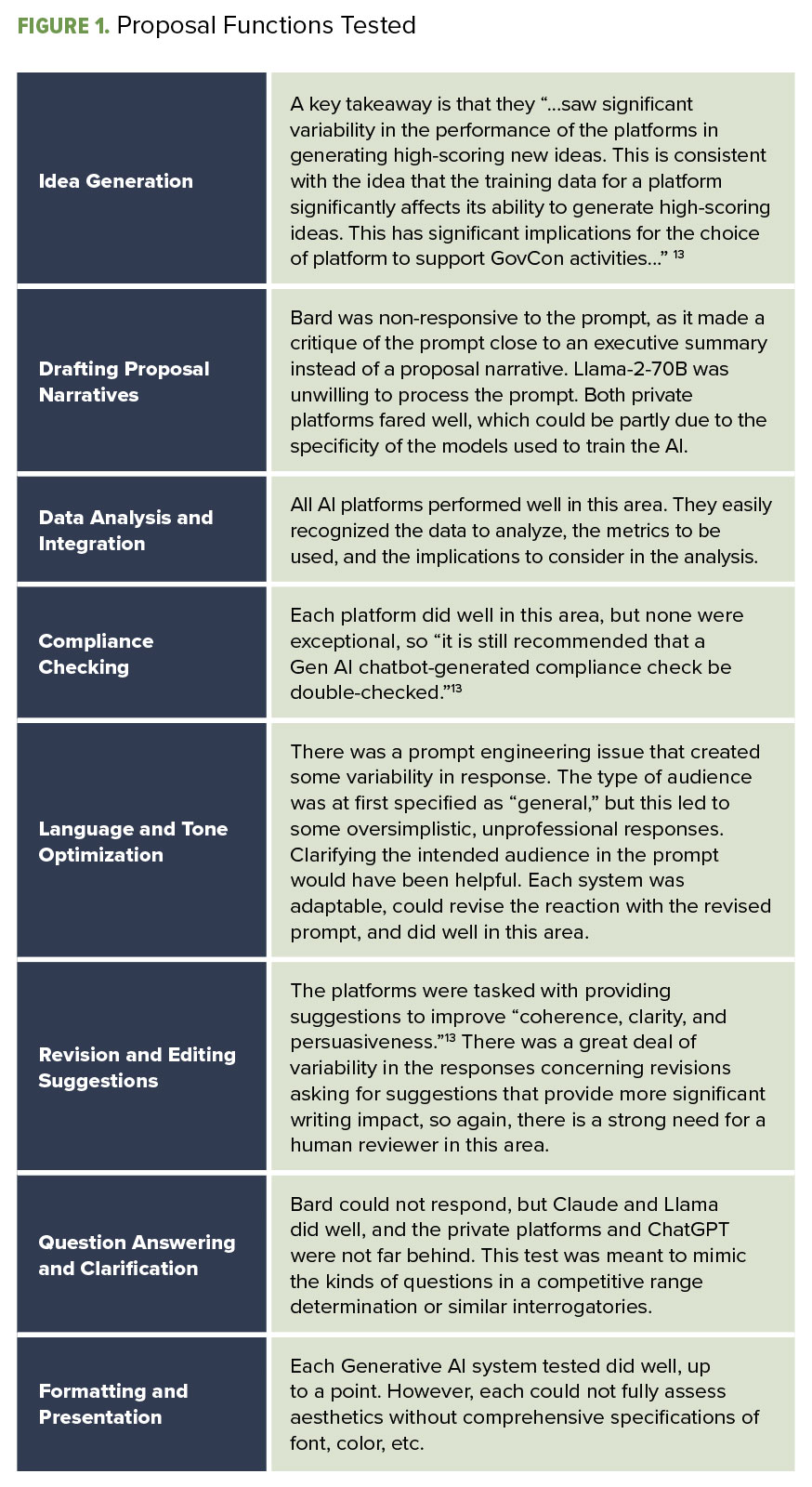
From 2023 to 2024, the federal government disclosed that AI use cases increased from 710 to 1,757. (9) That is a 148% increase in a single year! This figure speaks to the tremendous transformation happening in government agencies and industry. Here are a few examples of these AI-powered use cases for acquisition.
Use Case 1: DORA Bot
The Acquisition Innovation through Technology team at the Office of the Deputy Assistant Secretary of the Army for Procurement, or DASA(P), created the Army Determination of Responsibility Assistant (DORA) in 2019, and it was later adopted by the Navy, Air Force, and Defense Logistics Agency (DLA). (10) The DORA bot is currently being used by more than 8,000 contract professionals to drastically reduce the time to decide among prospective vendors for suitability for the award, bringing total time down from more than one hour to five minutes.
It can pull data from the SAM and the Federal Awardee Performance and Integrity Information System (FAPIIS) and predict the overall ability to perform on contract based on past performance and responsibility. This used to be an entirely manual analysis prone to error, so the DORA bot saves time, reduces errors, and increases compliance. (11) This also reduces the government’s overall cost by streamlining the process for contract professionals per contract action.
In late March 2024, the Office of the Inspector General (OIG) of the U.S. Department of Defense (DoD) released an evaluation of the DoD financial responsibility reviews on prospective contractors spanning use by the Army, Navy, Air Force, and the DLA. The OIG audited a sample of 59 contracts valued at $8 billion for compliance with FAR, DFARS, and DoD Component policies. The office found that there is still a large compliance gap in providing sufficient documentation to comply with contractor financial responsibility requirements.
The report also noted that because the DORA bot only searches FAPIIS and SAM, the bot analysis does not include updated financial information on prospective contractors, which was the most significant point of failure on the sample contract data. This highlights 1) the need to keep increasing the capabilities of AI tools for procurement and 2) that AI cannot replace professional competence; it can only augment and streamline the workflows for procurement professionals on both sides. The sharper our tools, the better we can perform.
Use Case 2: NIPRGPT
The Air Force Research Laboratory launched NIPRGPT as a secure research initiative for airmen and guardians on the Non-classified Internet Protocol Router Network. This allows them to interact with this Generative AI chatbot on various tasks.
They can import their work to create a personalized workspace to curate, synthesize, and generate data outputs like coding, document reviews, and summaries. They can also use it to create standard contract documents for Procurement Contracting Officers (PCOs) and Program Managers (PMs).
NIPRGPT can help streamline time-consuming and mundane processes and pave the way for AI-augmented tools that can process vast amounts of data quickly and efficiently to make acquisition teams more effective. (12) This tool also provides valuable training data on what airmen, guardians, and contractors want to use generative AI to accomplish, which will guide development as research continues. This will likely soon produce more specialized AI tools that can deliver even better results for procurement professionals.
Use Case 3: GSA Solicitation Review Tool (SRT)
The General Services Administration created the Solicitation Review Tool (SRT), which uses NLP AI to review bid solicitations. It can identify bids for information and communication technology (ICT) and then scan for inclusion of Section 508 Technical Requirements that improve accessibility of federal information technology. With SRT, agencies can decide which solicitations need to be amended to add the requirements before the agency makes selection decisions.
Other agencies are also rapidly developing AI tools. (13) The Army, Internal Revenue Service, Department of Health and Human Services, and Department of Homeland Security have already implemented AI, machine learning, and NLP tools that assist in various ways in decision support and data processing. Many more AI support tools will soon be available across agencies and industries. The applications for AI tools are endless, and the ways we use them will continue to grow and evolve.
Using AI for Proposals
Using generative AI and AI-powered tools for proposals and white papers is helpful and saves time, but AI tools still need extensive human oversight to create reliable outputs. AI-generated content can augment your proposal, albeit not quite as creatively or with as much impact as human efforts. However, AI tools already excel at data analysis, checklists, and compliance checking. This can easily translate into combining proposal data for useful patterns.
Beyond this, it could also be trained on your past proposals and responses received to predict what your customer has historically responded most favorably to and analyze client behavior patterns. Using your own proprietary data with predictive analytics could help increase your win rates.
AI-powered proposal tools are already available through Deltek, (14) GovGPT, (15) Rogue, GovSignals, and GovDash, (16) among many others. Some are comprehensive, and others assist with specific aspects of the proposal process, such as expanding technical volumes and following frameworks like CAS/FAR compliance and/or NIST 800-171 and FedRAMP Moderate Standards.
They can also assist with creating pricing data, basis of estimate (BOE) narratives, and automating compliance matrices. They are built on different generative AI platforms, both private and public.

A recent study, “Benchmarking Generative AI Tools for Proposal Development,” completed by Lohfeld Consulting Group in February 2024, assesses several generative AI platforms to compare their capabilities to perform critical proposal tasking.
The group looked at public and private platforms, and the two were designed explicitly for GovCon usage. It looked at OpenAI ChatGPT-3.5 (ChatGPT-4.5 is the current release), Meta Llama-2-70-b (Llama version 3.3 is the most current as of December 2024), Google Bard (now Gemini as of February 2024).
It also assessed Anthropic Claude Instant and Claude-2-100K (Claude 3.5 Haiku and 3.5 Sonnet are the most recent releases from October 2024) and two unnamed private platforms. For each function, Lohfeld provided a prompt scenario and the output format, ran the test prompt multiple times, and scored the outputs to build the benchmarks. Figure 1 summarizes many of the report findings.
This assessment was performed more than one year ago, and since then, each of these AI platforms and private and proprietary AI tools has made rapid gains. As such, further testing will be helpful as business development, technical, finance, and contract professionals try to choose the best AI-augmented proposal tools to augment the tasks that best support their organizational goals. AI is here to stay, and it is worth the effort to investigate what will give stakeholders the greatest return on investment.
Tips for Implementing AI-Tools
Use these tips to gain the most benefit from implementing AI-powered analytic tools:
- Organize your data. You need quality data to use these tools, and if your data is disorganized, significant investment will be required to pull historical data and ensure it is clean and accessible to best inform your AI and machine learning tools.
- Building accurate predictive models based on sound data and high-quality algorithms is imperative.
- You must continuously monitor and refine performance, sharpening these tools as you gain feedback on their output. You may also need to dedicate resources to manually “testing” the predictions periodically against older, tried-and-true prediction methods to see how well your AI tools are measuring up. (17)
An AI Prediction for the Future
According to a March 19, 2024 article in European Business Magazine, “AI will augment the capabilities of procurement teams and is expected to create 133 million new jobs by 2030.” (18) It’s not coming for your job, but it will change how you do business and help all contract professionals move faster while maintaining compliance and reducing risk.
Embracing AI-augmented business tools is the future (19) for all of us. AI is changing how we do business and will help us reach our goals in supporting the critical missions to serve our country and the future. This will increase the speed at which we can move through the contract lifecycle to support the warfighter and help us stay ahead of our near peers in the competition for mastering AI technology. (20)
By embracing AI-powered predictive analytics, government contract professionals can improve efficiency, reduce costs, and enhance overall contract performance. (21) By leveraging the power of AI, they can stay ahead of the curve and continue to deliver exceptional results. CM
Hannelore Sammons-Ginger is an industry contract & subcontract administrator focused on artificial intelligence, information security, and emerging technologies. She recently graduated from the Government Contracting & Procurement program at the University of Dayton School of Law (UDSL), and is also a UDSL Program in Law and Technology Fellow 2024-2025. She lives with her husband and two daughters in Tipp City, Ohio.
ENDNOTES
1 https://ncmahq.org/Web/Shared_Content/CM-Magazine/CM-Magazine-February-2023/AI-Is-Coming-For-Contracting.aspx
2 Tillipman, Jessica, Using AI to Reduce Performance Risk in U.S. Procurement (June 29, 2022). GWU Legal Studies Research Paper No. 44, 2022, GWU Law School Public Law Research Paper No 44, 2022, The Regulatory Review (June 29, 2022), at https://www.theregreview.org/2022/06/29/tillipman-using-ai-to-reduce-performance-risk-in-u-s-procurement/, 2022, Available at SSRN: https://ssrn.com/abstract=4203797
3 Program in Law and Technology Seminar, University of Dayton School of Law, Dayton, Ohio (11/1/2024).
4 https://geniusee.com/single-blog/ai-and-predictive-analytics#:~:text=While%20predictive%20analytics%20existed%20before,where%20predictive%20analytics%20is%20automated.
5 Bonnell, Alexis, Navigating our Relationship with Emerging Technologies, (NCMA, Contract Management Magazine, September 2024), 19-24.
6 https://digitaldefynd.com/IQ/pros-cons-of-predictive-analytics-in-ai/#:~:text=Analytics%20in%20AI-,1.,manage%2C%20and%20interpret%20AI%20models.
7 https://qz.com/1427621/companies-are-on-the-hook-if-their-hiring-algorithms-are-biased
8 https://wittscpa.com/the-future-of-government-compliance/
9 https://fedscoop.com/federal-government-discloses-more-than-1700-ai-use-cases/
10 https://www.route-fifty.com/digital-government/2020/10/how-the-armys-dora-bot-cuts-manual-work-for-contracting-professionals/315706/
11 Evaluation of DoD Financial Responsibility Reviews on Prospective DoD Contractors, Inspector General, U.S. DoD, 3/29/24, report DODIG-2024-072; https://media.defense.gov/2024/Apr/02/2003427125/-1/-1/1/DODIG-2024-072_REDACTED%20SECURE.PDF
12 https://www.vandenberg.spaceforce.mil/News/Article-Display/Article/3821906/niprgpt-the-department-of-the-air-forces-newest-initiative/#:~:text=%2D%2D-,VANDENBERG%20SPACE%20FORCE%20BASE%2C%20Calif.,intelligence%20tool%20known%20as%20NIPRGPT.
13 https://www.washingtontechnology.com/opinion/2024/02/just-how-good-gen-ai-helping-proposals/394185/
14 https://www.deltek.com/en/government-contracting/propricer#:~:text=Proposal%20Software%20for%20Government%20Contractors,data%20to%20win%20more%20bids.
15 https://www.gov-gpt.org/features/proposal-assistant
16 https://www.govdash.com/
17 https://federalnewsnetwork.com/commentary/2024/10/navigating-the-federal-ai-frontier-top-priorities-for-incoming-chief-ai-officers/>
18 https://europeanbusinessmagazine.com/business/will-ai-become-the-new-strategic-partner-for-procurement/#:~:text=A%20common%20misconception%20about%20AI,million%20new%20jobs%20by%202030.
19 https://www.cisa.gov/ai/recent-efforts
20 https://www.mayerbrown.com/en/insights/publications/2022/12/us-ndaa-for-fiscal-year-2023-important-changes-to-procurement-laws-and-policy>
21 https://www.leadershipconnect.io/federal-government/the-strategic-landscape-of-ai-a-guided-service-for-industry-leaders-decision-makers-and-federal-agencies/