An AI-Ready Mindset
By Alexis Bonnell
 Artificial Intelligence (AI) is leveling the playing field exponentially by enabling applicants with varying proficiency levels or contracting language expertise to produce higher-quality deliverables than was previously possible. In contracting, AI-powered language tools may help these applicants draft clear, professional proposals that meet necessary standards, allowing them to compete more effectively.
This democratization of the application process means that smaller companies, or those from non-English speaking or disadvantaged backgrounds, can now participate on an equal footing with larger, more established firms. As a result, the government can access a more diverse pool of innovative solutions and suppliers ultimately leading to potentially improved outcomes for public projects and procurement.
While AI holds great promise for transforming government acquisitions trials and timelines, certain aspects of the Federal Acquisition Regulation (FAR) present challenges in its implementation. The FAR’s stringent compliance requirements, designed to ensure fairness, transparency, and accountability, can make integrating AI more complex.
For instance, the FAR mandates extensive documentation and justification for decisions, which might complicate using AI-driven automated processes and predictive analytics. Additionally, the FAR’s emphasis on human judgment and oversight limits how AI can be optimized to facilitate procurement decisions or evaluate contractor proposals. (1)
AI proponents argue that AI can make much less biased decisions, and the assumption that human-based decisions are inherently unfair is not born out of historical context. (2) Data privacy and security requirements under the FAR could restrict the types of data AI systems can access and analyze, potentially hindering their effectiveness.
To fully leverage AI, acquisition professionals must navigate these regulatory constraints carefully and advocate for updates to the FAR that accommodate AI technologies’ unique capabilities and requirements.
The FAR could also be seen as providing a robust framework that can facilitate the adoption of AI in government procurement, offering numerous opportunities for innovation and efficiency. The FAR’s emphasis on thorough documentation and transparency aligns well with AI’s data analysis and record-keeping capabilities.
AI can help ensure compliance by automating the generation and management of necessary documentation, reducing the burden on procurement professionals. Additionally, the FAR’s focus on performance-based contracting can be enhanced with AI, which monitors and analyzes contractor performance in real-time, provides actionable insights, and ensures adherence to contract terms.
The flexibility within the FAR to utilize best value determinations allows procurement officers to leverage AI tools to assess and compare the total value of different proposals more effectively. Moreover, the FAR’s provisions for market research and competition can be significantly augmented by AI, which can quickly scan and evaluate market trends and supplier capabilities.
By embracing the FAR’s existing framework, procurement professionals can harness AI to streamline processes, enhance compliance, and deliver better value to the government and taxpayers.
So, how do we acquire AI tools and services today?
Acquiring AI Tools and Services
AI is set to fundamentally transform government acquisitions, offering unprecedented opportunities for efficiency and effectiveness. By understanding the different ways to procure AI tools and the areas where AI can add value, acquisition professionals can take charge of modernizing the Department of Defense (DoD) procurement processes.
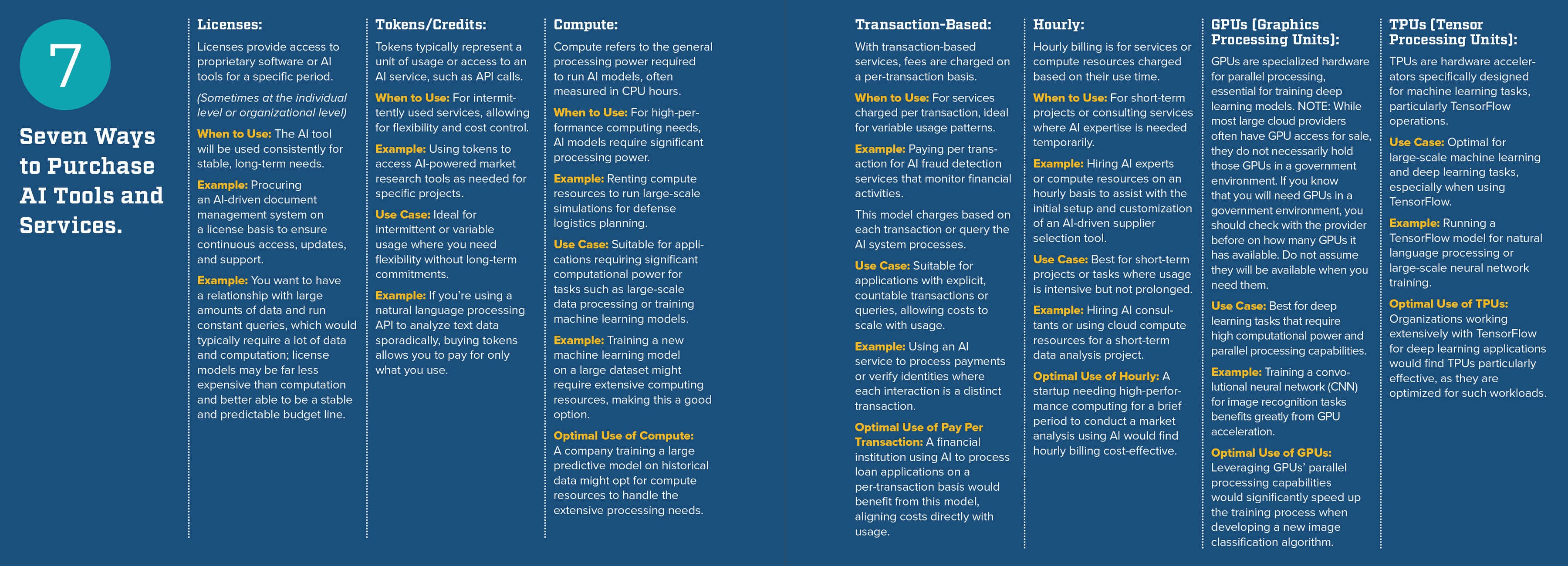
Because AI is sold by different vendors in different cost models, it is critical to understand the relationship between what knowledge we want to have, by whom, at what speed and what outcome. The government should not simply bow to the desired sales model of AI vendors and instead should be insistent on what method of buying is most appropriate for their use case.
See the chart, “Seven Ways to Purchase AI Tools and Services,” to explore options in this area.
Barriers to AI Adoption
While many are still trying to determine best practices for purchasing AI through these methods, some focus on the next step ... adoption. Technology adoption is critical to all parts of future government and especially for my mission – national security.
The Council on Foreign Relations affirms that the military sector benefits significantly from AI by enhancing decision superiority on the battlefield. (3) AI enables faster, more accurate decisions by quickly processing vast amounts of data, which is crucial in combat situations.
The DoD’s AI Adoption Strategy focuses on integrating AI into operations to improve situational awareness, force planning, and mission execution. This strategy ensures that AI capabilities are deployed responsibly and effectively to maintain a competitive edge. (4)
Being in emerging technologies for most of my career, I have learned one thing: technology is ultimately about people – about us. We dictate the usefulness or value of technology by assigning it a place in our lives. AI is no different.
When I guide government professionals through my AI 101 class, I emphasize vital principles and frameworks that distinguish a technology being thrust upon us from one that enhances our capabilities. The critical factor? Your mindset.
In my experience and observations, I have found three reasons people do not feel successful or have the “lightbulb on” feeling.
These three reasons are:
1. They outsource their point of view.
One of the most perilous behaviors for a public servant is relying on others to form opinions about new, novel, or controversial technologies. At Google, as the Emerging Technology Evangelist, I observed that most people’s opinions about AI were shaped by the last few things they heard. If those were negative, they felt negative; if positive, they were more intrigued. Extreme examples often became the norm in their minds, discouraging exploration and adaptation.
With AI, especially with accessible tools like ChatGPT, public servants and acquisition professionals must try the tools themselves. Only through personal experience can they form evidence-based opinions.
2. They are afraid.
Many people fear they won’t understand AI, perceiving it as too complex or beyond their qualifications. Policies and over-regulation exacerbate this fear, making individuals feel inadequate. However, the truth is, you are enough. As a public servant, you are expected to be moral and ethical; you don’t need special skills to wield AI effectively. Your experience helps you wield tools like Generative AI in your own unique and powerful way.
3. They feel like change is daunting.
Change can be intimidating, especially when we have spent years mastering a particular way of doing things. This mastery creates a sense of control and balance, making us resistant to change.
In government, we rarely stop doing things, accumulating tasks that eventually overwhelm us. Toil kills purpose faster than mission can rebuild it. So, while we are comfortable with things, more things are added until we are drowning in toil. When confronting a technology like AI that can help us curate information and knowledge at speed and scale, starting with the pains and problem sets is healthy. It’s like getting time back from the tedious, rudimentary tasks you feel stuck doing.
These common behaviors, as well as the need to ensure we could put critical evidence behind our decisions around AI, prompted us at the Air Force Research Laboratory to create NIPRGPT. It’s a safe, secure, and internal tool that airmen and guardians could use to experience AI for the first time in a familiar place. They didn’t have to worry about information being external or training any models.
From a research lens, it’s helping us understand how people want to use AI to help with their daily work or mission, how much compute or resources an AI-driven future might require and more about how to acquire AI tools effectively and appropriately in the near and long term.
Now, let’s talk about the journey and the stages of our relationship with technology adoption. This is important because after knowing how to acquire new technology and overcome our fears, we must also have long-term goals in mind. We must consider adoption in our organization and our daily practices and workflows.
The Emotional Phases of Technology Adoption
After being in the technology, change and adaptation business for more than 30 years, I saw that often people, vendors, and leaders jump in and start talking about a new technology, but they don’t take the time to say, “Why now?,” “Why our mission?,” “Why me?”
Those are real and valid questions I have found in my own behaviors and biases when someone only focused on the “what” and not the “why.” I might have changed or adapted how I do things based on the direction of a leader or new initiative, but I didn’t change how I thought or felt.
The thinking and feeling are actually the change; someone can make me “do” differently, but when they leave or leadership changes, etc., I wasn’t really invested. If they can help change the way I think and feel, and my values, the benefit of the technology became real and permanent.
Adoption is an emotional journey that is embedded in our individual senses of identity and unfolds in four distinct phases: “Ta-Da,” “Uh-Oh,” “Ah-Ha,” and “Ho-Hum.”
Ta-Da: The Wonder Stage
The “Ta-Da” phase is characterized by amazement as we encounter a capability previously beyond our reach. Early adopters seek out these “Ta-Da” moments driven by curiosity, while late adopters wait for the technology’s value proposition to be proven by others. In an era of exponential change, this curiosity is not merely a trait but a survival mechanism. Those open to new technologies generally gain personal, professional, and financial advantages.
For instance, many procurement professionals initially experience their “Ta-Da” moment with generative AI through simple interactions. Soon, they moved on to more sophisticated tools like Retrieval-Augmented Generation (RAG), which allows them to create work-spaces and curate documents focused on specific information. This makes AI an accurate ally in their unique work contexts, such as acquisitions and particular programs.
AI tools like NIPRGPT enable airmen and guardians to explore these capabilities within a secure government system. Users quickly transition from fundamental chat interactions to more advanced applications, appreciating the value of customized AI solutions tailored to their roles and projects. For example, they can create their own workspace that might import elements of the acquisitions they are working on, requirements documents, and even regulations like the FAR, to create a unique “MyGPT” where the data that is being searched, compiled and queried has been curated by them, instead of being a black box.
Uh-Oh: The Critical Stage
The “Uh-Oh” phase is crucial as it confronts potential challenges and changes AI brings. It’s a time of introspection where questions arise. “What could go wrong?,” “How does this affect me?,” “What changes are necessary?,” “How can I leverage this?”
Teaching AI 101 to more than 3,000 government and DoD personnel, I’ve encountered a common emotion – shame. Many feel that using AI is akin to cheating or shouldn’t be so easy. However, AI is about providing options, not definitive answers. It’s a tool that enhances your ability to curate information, leveraging your expertise and judgment.
Generative AI should not make you feel guilty for seeking options and insights. It’s about how you use the information you gather. If you don’t fact-check or seek balanced insights, that’s on you. The accountability for the data you choose to propagate remains unchanged with AI.
Ah-Ha: The Enlightenment Stage
The “Ah-Ha” moment is where the magic happens. You begin understanding how AI can genuinely help you, forming a productive human-machine partnership. This stage is about recognizing each other’s strengths and adjusting accordingly.
At AFRL, our “Ah-Ha” moments included using AI tools with publicly available contract documents. AI could digest data, provide summaries, and create Excel and Word documents with pertinent information. This functionality allowed Procurement Contracting Officers (PCOs), Program Managers (PMs), and others to review documents quickly, find relevant information, and generate necessary documents efficiently. AFRL tested AI’s capabilities with various scenarios and found it answered many questions more accurately than human counterparts.
In a mock warrant board test for becoming a Contracting Officer, AI nearly aced it, missing only a minor part of one question. Such “Ah-Ha” moments have validated the value of creating NIPRGPT for handling Controlled Unclassified Information (CUI) and justified investments in AI-focused procurement tools.
Ho-Hum: The Integration Stage
Finally, we reach the “Ho-Hum” stage, where technology becomes a routine part of our lives. Imagine meeting someone today who has never “Googled” something; it seems almost impossible. AI will likely become “Ho-Hum” even faster, seamlessly integrating into our daily tasks.
AI’s ability to manage and provide access to structured and unstructured knowledge aligns with our intrinsic human desire for curiosity and expertise.
Conclusion
Currently, the value of AI in acquisition is not about providing definitive answers but about creating a dynamic relationship with knowledge at speed and scale. It acts as a tool that enhances the capabilities of procurement professionals by curating a wide array of options quickly and efficiently.
AI excels at processing vast amounts of data, identifying patterns, and generating insights that might otherwise take humans considerably longer to uncover. This allows acquisition professionals to explore multiple scenarios, evaluate a broader range of suppliers, and make more informed decisions.
Rather than replacing human judgment, AI augments it by presenting a curated set of possibilities, enabling professionals to focus on strategic decision-making and nuanced analysis. In this way, AI empowers acquisition teams to navigate complex procurement landscapes with greater agility and precision, helping to foster better outcomes faster.
Embracing AI requires a shift in mindset – viewing it as a tool to enhance our capabilities rather than a threat. By navigating through the phases of technology adoption with an open mind and a willingness to adapt, we can harness AI’s potential to improve our lives and work.
“Ta-Da” moments fuel our curiosity and drive us to explore new possibilities. “Uh-Oh” stages encourage us to address challenges and fears, ensuring we approach AI responsibly. “Ah-Ha” moments reveal the true value of AI, helping us form effective human-machine partnerships. Finally, reaching the “Ho-Hum” stage signifies successful integration, where AI becomes a natural part of our daily routines.
As we move forward, let’s focus on overcoming barriers to AI adoption, fostering a mindset that embraces change and values personal experience over outsourced opinions. Together, we can navigate the evolving landscape of emerging technologies, crafting a future where AI augments our capabilities, enhances our knowledge, and strengthens our national security.
I look forward to the journey and the relationship we craft together, and I am excited about this technology’s potential to impact our future, our knowledge, and our national security. We got this! CM
Alexis Bonnell is CIO and Director of Digital Capabilities at the Air Force Research Laboratory, where she leads the development and execution of the information technology and digital transformation strategy, focusing on integrating advanced technologies to enhance warfighting capabilities across air, space, and cyberspace domains. Previously the Emerging Technology Evangelist, Chief Innovation Officer of USAID, and an early career at the Internet Trade Association, Bonnell has always focused on helping people and organizations adopt to change. With a career dedicated to pioneering emerging technologies and organizational culture change, she contributes to driving innovation and digital transformation within national security, ensuring operational efficiency and technological superiority. Bonnell’s efforts have been instrumental in leveraging AI and digital tools to support national security and defense initiatives.
ENDNOTES
1 For more information, see FAR Part 13.501, 6.303-1, subpart 4.8
2 For more information on this topic, see the following articles: McKinsey’s Report on Tackling Bias in AI and Humans, https://www.mckinsey.com/featured-insights/artificial-intelligence/tackling-bias-in-artificial-intelligence-and-in-humans; AI Ethics Journal on Fairness in AI Hiring, www.aiethicsjournal.org/10-47289-aiej20210716-3;
3 https://www.cfr.org/report/keeping-our-edge/pdf/TFR_Innovation_Strategy.pdf
4 https://www.cfr.org/report/accelerating-defense-departments-ai-adoption
DISCLAIMER: The articles, opinions, and ideas expressed by the authors are the sole responsibility of the contributors and do not imply an opinion on the part of the officers or members of NCMA. Readers are advised that NCMA is not responsible in any way, manner, or form for these articles, opinions, and ideas.