An analysis of the reasons why fostering innovation in contract management is so difficult, and several ways we can address these challenges.
BY JAMES RICH, PhD
“The very existence of flame-throwers proves that some time, somewhere, someone said to themselves, ‘You know, I want to set those people over there on fire, but I’m just not close enough to get the job done.’”
—George Carlin on innovation
Innovation has become the mantra of contract management organizations that feel the need to change their business processes, and to generally do so in a dramatic fashion.
In general, organizations see innovation as an enabler. It can help the organization scale to accommodate growth, develop a value proposition that is a positive differentiator, and create a work environment that attracts and retains top talent. Innovation is seen as a strategic tool that helps organizations become more agile, promotes better team dynamics, encourages an entrepreneurial spirit, and allows teams to more quickly identify customer needs and develop solutions.
With so much upside, you would think we would see hives of innovation at every level across the contract management community. But, while contract managers generally agree that an incrementalistic attitude toward change will not prepare us to address the challenges of the 21st Century, innovation and implementing large-scale change remain a challenge. Is this because the problems associated with innovation are so large and intractable, or are we not as committed to innovation as we think?
Innovation Got Off to a Rough Start
One of the certainties of risk management is that there will always be organizational pushback to introducing risk associated with change, particularly large-scale change. This is nothing new. In fact, this pushback has been present throughout human history.
Benoît Godin, a Canadian entomologist and professor at INRS (Montreal), notes that for a considerable period of our history, innovation was a pejorative term that represented heretical thought[1]—and for this particular period, being a heretic had potentially serious consequences.[2] Innovation was linked to contesting established norms of religion, politics, and social affairs. Innovators were viewed as trying to fix things that, to the masses and those in power, were not broken. Godin attributes the modern concept of innovation to the work of Austrian economist Joseph Schumpeter who, in 1939, identified the difference between invention—an act of intellectual creativity undertaken without any thought given to its possible economic import—and innovation—which drives firms to craft invention into constructive changes in their business models.[3]
In his seminal work, Diffusion of Innovations, Everett Rogers establishes that innovation is not so much an event as it is a process that operates within the confines of a social system.[4] Rogers’ theory identifies five categories of “adopters”—people who, for their own reasons, adopt (or don’t) innovation over time. The orderly progression of adoption and identification of the categories is set out in FIGURE 1.
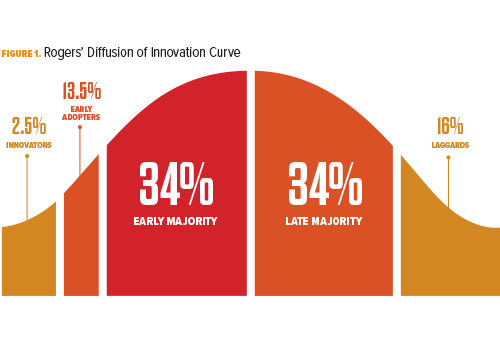
The segments move from left to right sequentially in order of adoption:
- Innovators,
- Early Adopters,
- Early Majority,
- Late Majority, and
- Laggards.
The cohorts are generally distinguished by their openness to change and innovation and to their risk tolerance. A unique characteristic of the Early Adopters is both their willingness to embrace change and, unlike the Innovators, they are more mainstream and typically have positions of authority and thought leadership. Early Adopters drive innovation because they see the need for changes and they are comfortable with adopting new ideas, technology, and policies with the understanding that there is an estimable risk of failure.
For anyone who has worked in a contracting office and observed how changes are adopted, this model should appear familiar. Some groups are open to change but want to see substantial evidence that the innovation, or policy change, will actually work. My personal experience is that this is true even when the change is issued as a mandate by the leadership of the organization. Slow rolling a new policy or innovation is common in organizations that, while not resistant to change, believe that purposeful delay is one way to ensure someone else does the trial and error. In Roger’s model, the Laggards represent that segment of the social system that will not buy in until there is a thoroughly tested proof of solution. By the time the Laggards have bought in, the Innovators are on to the next new disruptive idea.
We have come a long way on the journey to embrace innovation, and while we appear now to advocate for innovation and transformative change, there remains a lingering skepticism of strategies that propose to do too much too fast. That should not be surprising. Innovation is risky and failure is to be expected. So, is fear of failure why it is so hard to implement innovation in a contracting office?
This article focuses primarily on the federal government’s contract management model (because it is the largest and, arguably, the most doctrinally mature), but the concepts, principles, and problems examined should resonate with contracting professionals irrespective of where they work.[5]
Challenges to Innovation in Contracting
Contracting is a Rule-Bound Professional Discipline
There is no getting around this. There are a seemingly endless array of statutes and regulations that shape the acquisition environment. Notwithstanding the advice that the Federal Acquisition Regulation (FAR) is permissive if it does not specifically prohibit an action, the FAR system (to include agency supplements) is plenty proscriptive,[6] and attempting to innovate without regard to law and regulation is a risky venture I would not recommend. Implementing a truly game-changing innovation may require a change in the FAR or a federal statute—which, of course, is not easy. And, advocating for change requires time and patience, both of which are usually in short supply in the contracting office.
Those who advocate for innovation often call for substantial and immediate change—the “go big or go home” argument. Small scale change or half measures, the incremental approach, does not meet the moment. However, that approach is inconsistent with the way federal acquisition policy is made and implemented. The FAR system and the associated rule-making process require that change be the product of a deliberate process ultimately involving extensive public notice, review, and layers of approval.
The federal contracting bureaucracy is subject to a good deal of criticism for being unwieldy, slow, expensive, and difficult to understand for those outside government. While some of that criticism is richly deserved, it is not like the government has not tried to improve the efficacy and efficiency of its acquisition model. The Federal Acquisition Streamlining Act (FASA)[7] of 1994, the Federal Acquisition Reform Act (FARA)[8] of 1996, and the three-volume report and recommendations of the Section 809 Panel[9] were all efforts to make the contracting/acquisition process faster, more efficient, and more transparent.[10]
However, when you look at the substantial efforts over the past 40 years to improve the way the federal government contracts for goods and services and the current status of the contract management environment, it is easy to see why practitioners are looking for innovative solutions to problems that seem to resist all manner of efforts to solve them. Unfortunately, every attempt to solve such problems seem to result in more rules and a new set of problems.
Why Must Contracting Organizations Generate Change from the Top?
Where does innovation come from in the contracting organization? In the federal space, the answer is probably at the top of the organization or from a research group authorized by top management to explore the issue. There is nothing inherently wrong with that model if the polices promoted by leadership are monitored as each are implemented to ensure they permeate the culture of the organization. However, if mid-level managers or are not on board with the initiative, there will likely be less innovation driven down and, more important, none pushed up.
A serious issue for top-down models is the fact that a small percentage of all employees will have input on initiatives that are intended to shape the future culture of the organization. Models that drive change without regard to input from the organization seldom succeed in reshaping the collective values of the culture. The top-down thinker generates ideas that he or she consider sound, collects evidence of the soundness of their ideas by driving change throughout the organization via fiat, and the new vision is rolled out. However, evidence of true cultural adaptation and change with such a process may be hard to find.
Now consider another model. Imagine that you are a leader with substantial authority, and you want to transform the culture of your organization to embrace innovation. Do you take a top-down or bottom-up approach? In 1999, Dave Whitwam, the chairman and CEO of Whirlpool, wanted to increase the focus of the organization on innovation. Recognizing that relying on upper management to inspire innovation was not working, he issued a corporate goal of “innovation from everyone, everywhere.” Not a small goal or simple task; Whirlpool then had 68,000 employees in 170 countries, but Whitwam thought this was absolutely necessary if the organization really wanted to harness its employees’ intellect.[11]
There is plenty of employee intellect in the contract management community, so why don’t we hear more about great ideas for change coming off the “plant floor” of the contracting office? I think it has to do with what contracting professionals at the lower levels see as the “ceiling of the possible.” What innovation can we advocate for that has a reasonable chance of being approved? Most innovators operating at the base level of their organization have a sphere of influence that allows them to effect change within the parameters of their influence—and that influence tends to be more horizontal than vertical. Thus, initiatives at the base level of the organization tend to focus on data-driven issues—i.e., process and the day-to-day mechanics of the bureaucracy. Still, employees at any level of an organization can be key stakeholders who, while they may not initiate change, are essential to implementing and sustaining top-down directives that seek support for innovation.
It is hard to build momentum for large-scale change that seeks to alter core values of the existing culture. Organizations may identify individuals or business units to lead innovation, but those leaders, unless they are given the authority and resources to make culture-shaping decisions, will likely not succeed.[12] High impact, complex initiatives that require multiple waivers do not emerge from the bottom of the organization because they consume a great deal of time and effort and typically fail to make it to decision-makers with the authority to approve and execute the idea.
Change is easier to generate at the top of the organization if for no other reason than those at the top have the authority to approve the deviations and variances required to implement the change. Often, it’s not the merit of the solution proposed that leads to innovation but who champions it—and the bolder the idea, the truer that is.
Innovation Is All About Technology…Isn’t It?
Innovation, unlike creativity or invention, requires an actionable plan that offers new or novel solutions to meet emerging requirements, objectives, or goals of the organization. Though it may be inspired by creative thought or invention, innovation is an applied science that has real outcomes and consequences. It is not simply a new way to think about or frame a problem; it is the development and implementation of a solution to that problem—and it must be a solution that works.
Generally, innovation is associated with a process or product that not only represents an improvement but is also distinguished by its “newness.” A common and easily understood example of innovation is the application of technology to solve problems or boost productivity. (Think of a game-changer like the smartphone, or the potential of AI and robotics to impact the workplace.) However, technocentric solutions have led us to believe that all innovation involves complex technology. Unfortunately, the assumption that innovation in the workplace is the domain of those employees with highly developed IT or digital skills is both wrong and dangerous.[13] The push to innovate should be both an inclusive and empowering process. Employees who feel left out or left behind are less likely to support innovation initiatives they do not understand.
For many of us in contract management, innovation will not be all about the impact of hardware or software on the business model; it will be the deliberate examination of process and organizational structure in search of a demonstrably better way to do business. Other transaction (OT) authority utilization is a current example of process innovation.[14] And it’s a good example because it is normative in that it reflects the high risk/high reward calculus that we have come to associate with innovation.[15] OTs are specifically designed to attract businesses that typically do not do business with the federal government because of the complexity and high transactional costs associated with federal contracts.[16]
It's safe to say that contract managers will necessarily become more familiar with AI, Robotic Process Automation (RPA), Blockchain, and contract life cycle management (CLM) because the digitization of the contract process promises to add value, reduce the touch time for executing routine tasks, and convert contract files to an online searchable database.
Striking examples of federal technology innovation initiatives, often developed in conjunction with the private sector, currently deployed in contracting offices generally focus on important but routine processes that can be mapped and automated. The intent is to shift focus from lower-value administrative work to higher-value work requiring critical thinking that will help contracting professionals save time and make better-informed decisions.
Consider the U.S. Army’s “Determination of Responsibility Assistant” bot (DORA), which the Army estimates will eliminate human touch time in completing a contractor responsibility determination and reduce time to complete the formal determination from one hour to no more than four minutes with an error rate of zero.[17] Another example is the Internal Revenue Service (IRS)’s “Procurement BOT,” also developed in conjunction with the private sector, which provides contractor responsibility determinations using RPA, eliminates human touch time until the formal decision needs to be signed by an authorized official, and reduces determination completion times down to the 2–4 minute range.[18]
It is clear that the insertion of technology into the contract management process is not going away. Technology does not need any sleep, it is not bound to a nine to five mentality and it doesn’t get sick.[19] Plus—there is the fact that there are a large numbers of companies whose specific focus is the development of a workforce of technology subject matter experts that are available by contract. The challenge for contract managers is not their ability or desire to become tech savvy, but the ever present and real threat that the function of technology insertion will be outsourced.
Risk Taking Can Be Really Risky
The contracting community is not a seamless web of risk-takers. Public sector contract managers, in particular, are typically characterized as conservative when it comes to assessing risky solutions. Procurement professionals are accused of putting compliance to regulations and avoiding any possibility of challenge or dispute right at the top of their priority list.[20] But, one could argue this behavior is both rational and to be expected. When you see careers derailed because people took risks that failed, you understand the unwillingness of contracting professionals to embrace risk and uncertainty. Notwithstanding the islands of innovation in public sector contracting that embrace prudent risks and do not penalize the well intentioned “fast fail,” contract managers are generally cautious when it comes to innovation. There is a good deal of out-of-the-box thinking that results in within-the-box solutions. However, the good news is that enlightened risk-takers may have simply defined a bigger box.
An interesting aspect of the characterization of the contract manager as risk averse is that it appears to be somewhat sector specific. Public-sector contract managers are thought to be more risk averse and to exhibit less entrepreneurial spirit than their private-sector counterparts—and evidence of this alleged discrepancy is not hard to find. For example, the 2018 Federal Employee Viewpoint Survey found 60% of civil servants feel motivated to come up with new and better ways of doing things, compared to 76% in the private sector.[21]
However, the data from studies that have specifically examined this alleged disparity are inconclusive. For example, one such study[22] suggests that public managers are not more risk averse or anchored to the status quo than private sector managers, but the incentive structures in the sectors differ sufficiently to suggest risk-taking and entrepreneurial behavior may be rewarded more in the private sector. That finding supports the surge in public-sector initiatives to reshape the organizational culture by incentivizing prudent risk, business acumen, and entrepreneurial behavior (i.e., the drive to become more “businesslike”).
An excellent example of an initiative that addresses the issue of public sector risk management is the Department of Homeland Security (DHS)’s Procurement Innovation Lab (PIL), implemented in March 2015. In their words, “the PIL provides a safe space to test new ideas, share lessons learned, and promote best practices.” The PIL aims to improve the efficiency and effectiveness of procurements by:
- Lowering entry barriers—for innovative, nontraditional contractors to compete for DHS business opportunities;
- Shortening time-to-award—thereby delivering capability to the customer faster;
- Encouraging competition—by providing interested vendors with a greater understanding of the goals and objectives for each procurement; and
- Increasing the likelihood of successful outcomes—by focusing on evaluation techniques to obtain the most qualified vendors.
DHS employs the PIL not as a decision-making body, but as an internal consultant to decision-makers. Contracting officers and program managers choose to submit their project to the PIL for review and recommendation.[23]
There are many best practices associated with prudent risk management, but contract managers would like to know if there is some degree of indemnity that comes with implementing best practices. If you want to kill prudent risk-taking, just punish the prudent risk-taker whose initiative failed. We can certainly improve our training of contract managers on the importance of contract language transparency and how to assess risks, but that training is wasted if the employee returns to an organization that is deeply committed to the status quo.
Procurement Laws Don’t Keep Up with Technology
Procurement law is influenced by many things—including rapid changes in technology. However, the development of public policy and law is typically a reactive measure; policy is promulgated and a law is passed to respond to a signal from the markets, the courts, or public sentiment that a practice needs to be regulated, incentivized, etc. With respect to the application of technology to procurement practices, law and policy will always be lagging indicators.
One policy example unrelated to contracting, but one that dramatically exhibits why policy always lags innovation, concerns the autonomous (self-driving) car. If a self-driving car is involved in an accident, who is responsible? The mature legal and policy model that we have relied on for many years is out the window. (What if two driverless cars run into each other?) Is the “driver”—who isn’t even driving—still responsible, or is it the owner of the car, who may or may not be driving? Perhaps the manufacturer of the vehicle will have legal responsibility, the company that makes the sensors, or the firm that wrote the software code for the vehicle’s collision-avoidance/traffic-management system?[24] Once we see a critical mass of autonomous cars on the highway, we will see a flood of legislation, regulation, and lawsuits—because that’s the way the system works.
While the generation of new procurement policy may necessarily be reactive, it need not be slow. There are times when the need to provide guidance or extend new authorities is so compelling the system responds relatively quickly. Currently, the threat of the United States losing technological dominance to near peer adversaries is a powerful motivator that has put the focus on the ability of the system to speed up the rule-making process and support partnering arrangements between industry and the government.
Public procurement officials and bureaucrats in general do not generate policy. Policy reform is typically a task for elected officials. Unfortunately, procurement reform is a challenging time- and resource-consuming activity that does not generate the positive and highly visible publicity that many politicians seek. Thus, it is not easy to find a political champion for something as stodgy and uninspiring as changing the rules of contracting. This is truer for procurement reform at the state and local level than reform of federal procurement statutes, probably due to the sheer scale of the federal spend. At some point, how you spend $580 billion annually gets a good deal of attention.[25]
From the standpoint of the contract manager at any level of his or her organization, it is easier to design a policy “work around” than attempt to fix the underlying policy. Hence, you wind up with the written version of procurement policy and the “way you really handle this situation.” Interestingly, “work around” rules, while not based on official authority, become part of the culture as an expression of organizational habit and inertia. They may be cultural lore, but to a new employee in a contracting office the authority of lore will seem every bit as powerful as policy actually generated from statute.[26]
Do We Know What to Fix?
The contract management issues addressed in this article, though they occur across sectors of the economy, are all domestic examples, but the international data on public procurement innovation is strikingly similar. The Organization for Economic Coordination and Development (OECD) Survey on Strategic Innovation Procurement, covering 35 countries, assessed the strategic use of procurement for innovation in OECD Member countries and non-Member economies. A key finding of the survey identified the most common challenges countries face are related to risk aversion, management, personnel and skills capacity, and political support.[27] Sound familiar?
If we want to foster innovation in contract management, we have a pretty good idea what to fix, or at least where to start. But the “how,” as usual, is more problematic. Fortunately, there have been a great many lessons learned by those who have studied the role of innovation in the procurement process. I have tried to capture a few that I think are well supported by the research and, more important, are achievable with good leadership and not necessarily vast financial resources. The following is a very short list of the many initiatives that are underway in contract management offices around the world, but you can use these recommendations to do a cursory self-assessment of how your organization is currently managing innovation and change:
- Build a staff that is open and prepared to accept and operationalize innovation—This will take time and resources, but you will need competent, well-trained professionals to transition to a future-ready office.
- Raise awareness by publishing best practice cases, creating a dedicated knowledge-sharing platform, and/or hosting workshops and seminars to share and build success—Get the word out about what you are doing and why.
- Have leadership support at every level of the organization that is committed to sponsoring innovation—It is critical that innovation is owned by the workforce, not only those in leadership positions. Support technology and innovation performance criteria for all managers. It sends a positive message about how seriously the organization is invested in innovation and upskilling the workforce.
- Encourage employees to be creative and to not be afraid to bring their creativity to work—Google famously allows their employees to spend 20% of their time working side projects. That is not a reasonable goal for most organizations, but there are many ways to reward creativity exhibited by the workforce. Highlighting creativity and innovation can be as simple as acknowledging individuals and teams that bring new ideas and alternative solutions to the table.
- Do a Lean event to identify barriers to creative thought and innovation—You should not have trouble finding barriers to innovation in a contracting office. And invite the lawyers while you are at it.
- Encourage after-action reviews that respect honesty and candor—There will always be failures, but the real problem occurs when failures don’t become lessons learned. Hiding failures ensures that someone will repeat the failure; probably someone who was not associated with the original failure.
- Innovation initiatives need to be considered as an important part of the new culture—Formalize the development and implementation of innovation initiatives. Make sure everyone in the organization knows what the initiatives are and what the associated goals are. Employees want to support positive change, but generally disapprove of secret agendas or pet projects.
- Train your workforce to understand the difference between innovative buying strategies and buying innovation[28]—Both are important but different and may involve different skill sets.
- When it comes to researching innovation, go broad—Look at other agencies, different levels of government, industry, and international experience. You may discover some new and exciting ideas or you may learn that your planned initiative has been tried elsewhere and failed, which simply means you can abandon the idea or that you will be better prepared to launch it once you go over the lessons learned from the failure.
- Make sure you are innovating in alignment with your organization’s mission and vision—There is a big difference between an employee seen as a creative thinker and an employee considered an irresponsible maverick.
- Emphasize to employees that the goal of good contracting is a quality product and a happy customer, not merely rigorous compliance with regulation—Compliance is critical, but a fully compliant contract with terrible outcomes is not a win for the contracting office. The workforce that is best prepared to be innovative is also the workforce that is well trained and has an excellent working command of applicable law, policy, and regulation. Do not allow risk taking until the employee is prepared to assess the risk in the context of a legally compliant plan.
- Be honest about the necessity of change and the turmoil it can cause if not properly managed—Change will happen whether you prepare for it or not. You can’t future-proof the organization by simply assuming away the existence of looming challenges.
Trying to run an effective contracting office, encourage creativity and innovation, and develop a robust training regimen for employees is not easy (and it will not likely get easier or cheaper). Which is to say, if you are not already working on those things now, it’s a good time to start. If you are an employee, now would be a good time to prepare to be a highly qualified member of the future workforce.
Conclusion
Since the outbreak of the COVID-19 pandemic, full-time teleworking numbers have skyrocketed. This was out of necessity. However, pre-pandemic, telework was on a significantly slower track for adoption than had originally been projected, the inertia attributed to a sticky work culture and leadership that was unwilling to invest in the technology and management practices necessary to implement and sustain a telework environment.[29]
One outcome of the conversion to a virtual work environment—embracing technology we may have once found daunting and unnecessary—is that many of us are now able to do things that we would have sworn could not be done (pre-pandemic). I would argue there is no going back—at least, not all the way back. This experience has expedited our movement along Rogers’ “diffusion of innovation” curve and shaped the new normal. We are now more open to technology insertion and new ways of thinking about how we employ human capital because we were forced to try new ways to do things and, for the most part, they worked.
Once an employee (or manager) learns he or she can be as productive from home and forgo the three-hour-a-day commute, getting him or her back to the office is going to present some challenges. And smart leaders are thinking about how much money could be saved if telework allowed them to reduce the footprint of their leased real estate and other pre-pandemic, “normal” expenses—money that may now be reinvested in an increased/improved telework infrastructure.
James Rich, MPA, PhD
- Faculty Program Coordinator, Procurement and Contracts Management Programs; School of Continuing & Professional Studies, University of Virginia.
Endnotes
[1] Benoît Godin, Models of Innovation: History of an Idea (MIT Press, February 2017).
[4] Everett Rogers, Diffusion of Innovations, fifth ed. (Free Press: 2003).
[5] The purpose of this article aligns with the primary goal of the National Association of State Procurement Officials (NASPO)—i.e., professional development with a focus on creating and delivering innovative research, education, and learning opportunities. For more information, visit https://www.naspo.org/.
[6] See, e.g., the discussion of the FAR’s permissiveness in Terrence O’Connor, “‘Where Does It Say We Can’t Do That?’—How the FAR Advocates (and Encourages) Agency and Contractor Innovation,” Contract Management Magazine (June 2019): 20.
[8] Enacted as Division D of the National Defense Authorization Act (NDAA) for Fiscal Year 1996 (Pub. L. 104–106). Together with the Information Technology Management Reform Act of 1996 (Division E of the 1996 NDAA), it is known as the Clinger–Cohen Act.
[9] See, generally, https://section809panel.org/.
[10] But while FASA and FARA addressed issues that needed attention, the author is not sure, by today’s standards, either would be characterized as particularly innovative. The 809 Panel reports, if fully implemented, might be a different story.
[11] Nancy Tenant Snyder and Deborah Duarte, Strategic Innovation (San Francisco: John Wiley and
Sons, 2003): Chapter 1.
[12] See, generally, Jesse Nieminen, “Top-down or Bottom-up—How to Build an Innovative Culture?” VIIMA
(March 28, 2019), available at https://www.viima.com/blog/top-down-vs-bottom-up.
[13] See, generally, “What is Government Innovation,” Apolitical (February 1, 2019), available at https://apolitical.co/en/solution_article/what-is-government-innovation.
[14] See, e.g., Kathrine Higley, “An Award In 3 Minutes…Is Your Business Ready?—How to Stay Competitive in the Other Transaction Agreement Environment,” Contract Management (July 2019): 46.
[15] See, generally, Mary Beth Bosco and Eric Crusius, “The Question of ‘Other Transaction’ Protest Jurisdiction: Recent Decision Forecloses Yet Another Bid Protest Venue,” Contract Management Magazine (April 2020).
[16] Interestingly, contractors note that it is not the federal requirements that are overly complex or expensive—it’s the cradle-to-grave federal contract process. It’s no wonder, then, that some requirement owners want to use OTs simply because, from their perspective, they get to avoid the FAR.
[17] Elizabeth Chirico and John Burchill,”Innovation Through Technology,” Army AT&L Magazine (December 10, 2019), available at https://asc.army.mil/web/news-alt-jfm20-innovation-through-technology/.
[18] See Jack Corrigan, “IRS Turns to Automation Amid Shrinking Workforce,” Nextgov (April 8. 2019), available at https://www.nextgov.com/emerging-tech/2019/04/irs-turns-automation-amid-shrinking-workforce/156161/.
[19] See Arjen Van Berkum, “Contract management 2.0: Why Technological Applications Boost Outsourcing Results” (July 8, 2019), available at https://www.arjenvanberkum.nl/technology-2/contract-management-2-0-automation-in-contracts/.
[20] See, generally, Peter Smith, “Risk Aversion in Public Sector Procurement,” Public Spend Forum (October 18, 2016), available at https://www.publicspendforum.net/blogs/peter-smith/2016/10/18/risk-aversion-in-public-sector-procurement/.
[21] As cited within Courtney Buble‘, “New Report Showcases Initiatives Including a Procurement Lab and Virtual Internship Program,” Government Executive (November 1, 2019), available at https://www.govexec.com/management/2019/11/how-five-federal-agencies-fostered-innovation-report/161009.
[22] Sean Nicholson-Crotty, Jill Nicholson-Crotty, and Sean Webeck, “Are Public Managers More Risk Averse? Framing Effects and Status Quo Bias Across the Sectors,” Journal of Behavioral Public Administration, 2(1) (2019): 1–14.
[23] See Department of Homeland Security, “About the PIL” (March 9, 2020), available at www.dhs.gov/About%20PIL.
[24] See, generally, Donny Jackson, “As Technology Changes Rapidly, Policies Lag Too Far Behind,” IWCE Newsletter (May 5, 2016), available at
https://urgentcomm.com/collections/as-technology-changes-rapidly-policies-lag-too-far-behind/?pg=2.
[25] See, e.g., Daniel Snyder, “Federal Contract Spending Trends: Five Years in Five Charts,” Federal New Network (January 22, 2019), available at federalnewsnetwork.com/fiscal-2019-federal-contracting-playbook/2019/01/federal-contract-spending-trends-five-years-in-five-charts/.
[26] See, e.g., Mariam Pallathucheril, “The Pain of Public Procurement: Process (Part 4),” ELG (July 24, 2018), available at https://medium.com/coprocure/the-pain-of-public-procurement-process-c2e16214255c.
[27] OECD, “Public Procurement for Innovation Good Practices and Strategies” (June 2, 2017), available at http://www.oecd.org/gov/public-procurement-for-innovation-9789264265820-en.htm.
[28] See, generally, Peter Smith, “Procurement of Innovation and Innovative Procurement—What’s the Difference?” Spend Matters/UK Europe (May 10, 2018), available at https://spendmatters.com/uk/innovation/.
[29] See Katherine Guyot and Isabel Sawhill, “Telecommuting Will Likely Continue Long After the Pandemic,” Brookings (April 6, 2020), available at https://www.brookings.edu/blog/up-front/2020/04/06/telecommuting-will-likely-continue-long-after-the-pandemic/.