Contract Options 101
How contract options offer flexibility and efficiency for contract managers.
By Joel Dimaapi CPCM, MSOM
 As we enter the second half of the federal government’s fiscal year, more than ever, contracting officers and their customers are engrossed in developing their acquisition strategy and putting together their requirements package in order to award their contracts by September 30, 2024. This is especially true with large contracts for services. The bigger and more complex the project, the longer it takes to award the contract.
As the months progress towards the third and fourth quarters of the fiscal year, there is a buildup of momentum and activity to ensure follow-on procurements or option exercises are ready to sustain the continuity of services.
Contracting officers as well as contracting officer representatives, program managers, project managers, comptrollers, and other stake-holders work collaboratively to minimize the risk of gaps or disruptions in the flow of goods and services to the federal government.
During this challenging period, time is critical in executing the acquisition objectives of the organization and often, there is very little or no room for errors or rework. Incorporating options into an acquisition strategy can provide flexibility and save valuable time for the contracting officer and the organization.
How Options Work
The Federal Acquisition Regulations (FAR) Subpart 2.101 defines an option as “a unilateral right in a contract by which, for a specified time, the government may elect to purchase additional supplies or services called for by the contract, or may elect to extend the term of the contract.” (1) The FAR also provides contracting officers with the flexibility to include options in government contracts under the right conditions and circumstances.
Exercising an available option is the government’s unilateral right under the contract’s terms and conditions. Although options are included in a contract, the government is not required to exercise an option. If the government decides to move forward to exercise an option, in most cases, the contractor must deliver the supplies or services under the terms of the option at the agreed-upon pricing.
However, at the same time, the government is under no obligation to exercise a contract option. Additionally, even when the government exercises an option, there is no guarantee that the aforementioned option will be fully funded. In those cases, specific agency incremental funding procedures will be in place. See FAR 52.232-22 for more details and information. (2)
Advantages of Contract Options
Incorporating options into government contracts offers significant advantages for the government for the following reasons:
1. Provides significant flexibility by saving time and effort in terms of awarding a new contract and reducing procurement administrative lead time. (3)
2. Saves money since the contract was competitively priced in a way that vendors and contractors built the lower price (in their quotes or proposals) in anticipation of options (although not guaranteed) being exercised down the line equating to continuous revenue stream for their company. Pricing for the option is already agreed to in the base contract, which facilitates effective planning/budgeting on behalf of the government.
3. Minimizes risk for both contracting parties as exercising an option promotes continuity of services and goods for the government as well as steady source of revenue for contractors and vendors.
4. Facilitates long-term business relationships between the government and its industry partners resulting in a win-win scenario.
When Options Are Not Recommended
Options may not be the best fit if an indefinite-delivery, indefinite-quantity (IDIQ) or requirements contract would be better suited than a contract with options. (4) However, IDIQ and requirements contracts can also have options if the agency has determined it to be appropriate and in their best interests.
Options are not recommended when future requirements for supplies are likely to be trivial, involving minimum quantities where producing them will be cost prohibitive for the supplier or recovering start-up costs is unlikely.
Furthermore, options may not be the best alternative if conditions exist (i.e., adequate time and opportunity) to permit a full follow-on competitive acquisition, manufacture, and delivery of goods and services.
More importantly, contract options are inadvisable during times of severe economic uncertainty when prices and availability of raw materials as well as fluctuating labor conditions present inherent risks to the contractor or vendor. The same is true when future pricing for materials or labor costs cannot be accurately estimated.
Acquisition Planning Is Key
Contracting officers and their agencies need to plan ahead as much as possible to understand the problem they are trying to solve. Each stakeholder needs to invest time and effort to determine from the onset whether it’s in their best interest to include options in the resultant contract. Options will allow for an increase in the quantity of supplies or volume of services in the base contract or an extension to the services’ period of performance (POP).
Generally speaking, contracting officers and their agencies consider including options in their contracts when there is reasonable expectation the supplies or services may be needed in the future, funds will be available, and the continuity of operations is critical to minimize disruptions in the agency’s mission performance.
It is worth mentioning that FAR 17.205(a) requires the contracting officer to prepare a written justification document (i.e., memorandum for file) detailing quantities or the term under option, the notification period for exercising the option, and any limitation on option price under 17.203(g). (5) This justification is required prior to posting the solicitation and shall be part of the contract file.
.jpg?version=CA35B0D3)
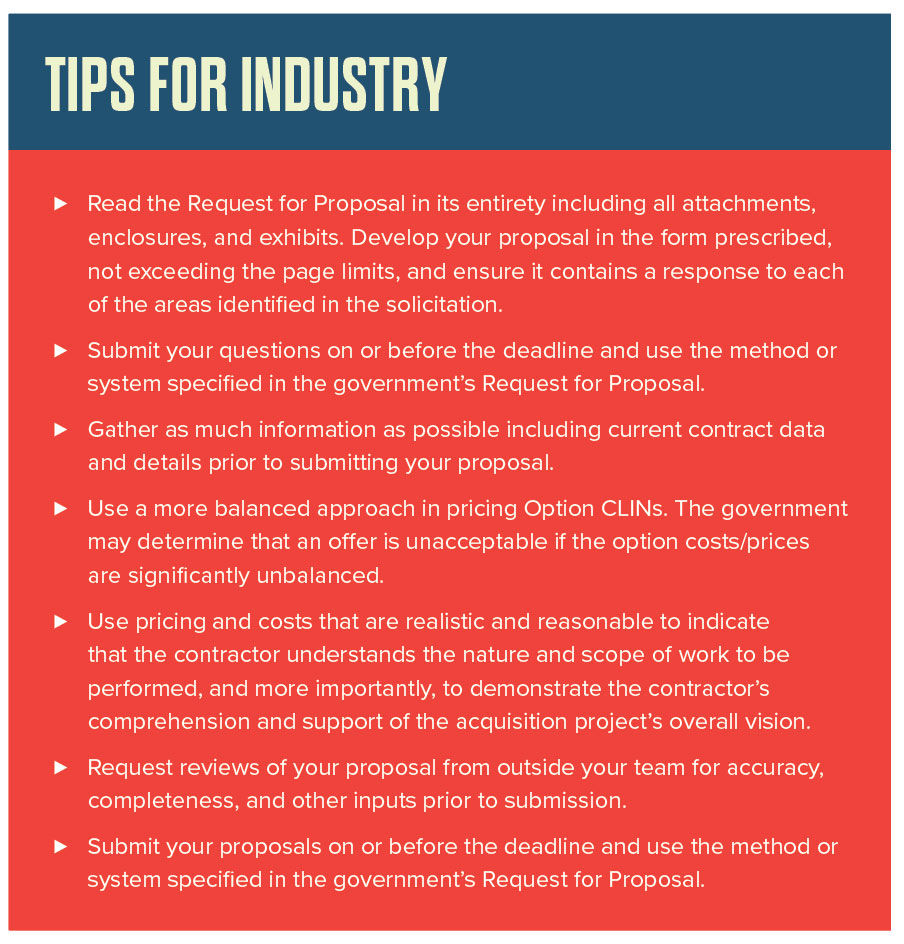
Provisions for Solicitations With Options
After a determination has been made that it is in the government’s best interest to include options in a contract, the contracting officer must add the applicable provisions and clauses in the solicitation.
Furthermore, it is critical to address how the proposals will be evaluated. Solicitations with option provisions shall state the basis of evaluation, either exclusive or inclusive of the option and, when appropriate, shall inform offerors that it is anticipated that the government may exercise the option at time of award. (6)
FAR 17.208 provides contracting officers a list of solicitation provisions and contract clauses that may be customized to accommodate the agency’s needs. (7) The list includes the following:
52.217-3 EVALUATION EXCLUSIVE OF OPTIONS
Use this provision when option pricing will not be included in the evaluation for award purposes. Also, use this provision when the solicitation does not include either FAR 52.217-4 or 52.217-5. (8) Moreover, if the agency decides to exercise option(s) that were not evaluated, the contracting officer must complete a justification and approval (J&A) document prior to execution. (9) A J&A is a document required by law that explains the basis or justification and the approval obtained for solicitations that use other than Full and Open Competition. See FAR Subpart 6.3 for specific use and application of J&As.
52.217-4 EVALUATION OF OPTIONS EXERCISED AT TIME OF CONTRACT AWARD
Unless it has been determined not to be in the government’s best interests, contracting officers are required to evaluate the total price for the basic requirement together with any option(s) exercised at the time of award. (10) Use this provision when the solicitation includes an option as a priced Contract Line Item Number (CLIN), an option clause and the possibility or expectation of exercising the option. More importantly, exercising the option may occur at the time of contract award.
52.217-5 EVALUATION OF OPTIONS
This provision is very similar to FAR 52.217-4. In this case, contracting officers need to evaluate offers for award purposes by adding the total price for all options to the total price for the basic requirement unless it has been determined not to be in the government’s best interest. Evaluating options will not obligate the government to exercise the aforementioned options. (11)
This provision is included when the solicitation contains an option clause and exercising an option is not planned at the time of contract award. Typically, this provision is used for firm-fixed price, fixed price with economic price adjustment, or other types of contracts as specified by agency procedures. Also, the contracting officer needs to determine that there is the possibility or expectation of exercising the option(s).
It is worth mentioning that contracting officers must evaluate proposals strictly adhering to the procedures defined in the solicitation, including the provisions for the evaluation of options.
For compliance purposes, solicitations must have options listed as separate CLINs. The same is true for the contract extension using FAR 52.217-8 Option to Extend Services (not to exceed six months total). This is to ensure that contractors and vendors will price these CLINs separately for the contracting officer’s evaluation of proposals received. The options and extension using FAR 52.217-8 need to be included in the evaluation as separate and priced CLINs (12,13) If not, the contracting officer will need a justification and approval document before exercising the extension. (9)
Clauses for Contracts With Options
A contracting officer can include one or more option clauses in the contract deemed appropriate for their agency needs and mission objectives. Additionally, the resultant contract needs to spell out what the contractor must provide for the option in terms of supplies or services, the limitations of the option quantities, and, at what price. The list of contract option clauses includes the following:
52.217–6 OPTION FOR INCREASED QUANTITY
This clause is appropriate for supplies contract with an option quantity. It includes a fill-in portion that the contracting officer must complete by identifying the period of time within which the option must be exercised. This clause allows the government the flexibility to increase the quantity of supplies called for in the Schedule at the unit price specified. (14)
52.217–7 OPTION FOR INCREASED QUANTITY – SEPARATELY PRICED LINE ITEM
This is a fill-in option clause for supplies when the option quantity has been awarded as a separately priced CLIN. The additional amounts may be ordered by the government at the contracted price contingent upon the contracting officer notifying the vendor within the contract’s specified period of time. (15)
52.217–8 OPTION TO EXTEND SERVICES
Use this fillable clause when the government may require continued performance of any services within the limits and at the rates specified in the contract. Rates may be adjusted only as a result of revisions to labor wage determinations published by the Department of Labor and upon request of the contractor within the specified contractual timeframe.
This option clause may be exercised more than once, but the extensions shall not exceed a total of six months. Moreover, the contracting officer must provide written notice to the contractor within the contract’s specified time frame prior to exercising the option. (16)
52.217–9 OPTION TO EXTEND THE TERM OF THE CONTRACT
This clause is appropriate for contracts where the government may require extending the term of the services provided through a written preliminary notice to the contractor within the specified contractual time frame of its intent before the contract expires.
Furthermore, the preliminary notice does not commit the government to an extension. The official extension shall be in the form of a contract modification issued by the contracting officer. This fillable clause requires the contracting officer to indicate the contract’s total duration in number of months or years. (17)
The complete description and prescription for each provision and clause listed herein can be found in the acquisition.gov portal. (18)
As a contracting officer for almost 20 years, I have found contracts with options to be very useful, especially towards the end of the fiscal year crunch when time is of the essence.
Including options in a contract is worth the upfront time and effort invested. Beyond the typical contracts for administrative, maintenance, technical, and engineering support services, we regularly included options for cellular task orders (Firm Fixed Price/FFP) from the Navy’s SPIRAL 3 IDIQ, Multiple Award Contracts (MACs).
We also awarded task orders with options using the Navy’s SeaPort-NxG platform. It is an IDIQ for 23 functional service areas in Engineering, Financial Management, and Program Management.
During the acquisition planning, we ensured that the options did not extend beyond the POP of the MAS contract including its option year periods. This consideration should always be part of the overall strategy. The agency and its customers benefitted greatly from the options included in these task orders. Moreover, due to the success of including options in these contracts, options became an integral part of every acquisition planning and strategy moving forward.
With the appropriate circumstances and proper context, taking advantage of options for a contract is a smart move, very sensible, and downright effective. CM
Joel Dimaapi, CPCM, MSOM is currently working as a Senior Contracts Specialist for the Next Generation Contracts Group (Acquisitions Directorate) U.S. Department of Education Office of Federal Student Aid. He provides support administering, maintaining and executing robust, cloud-based, innovative applications contracts for USDOE FSA enterprise customers with a portfolio grand total in excess of $280 million. Dimaapi provides mentorship, advice, and coaching in areas of leadership, motivation, performance improvement, goal setting, time management, as well as Navy Core Values. He is a retired Naval Officer (Information Systems Designator) with more than 23 years of service and has been a Federal Acquisition Professional Community Member since 2003. He has more than 33 years of combined military and civilian service in contracting, information technology as well as supply and logistics in the Navy.
This document/article was written in the author’s personal capacity. The views expressed and presented in this article are solely those of the author and do not necessarily represent the views of the Department of Education, Office of Federal Student Aid or any of its components.
ENDNOTES
1 FAR 2.101 Definitions
2 FAR 52.232-22 Limitation of Funds
3 The Office of Federal Procurement Policy (OFPP) Memorandum dated January 14, 2021, defined the Procurement Administrative Lead Time (PALT) as “the time between the date on which an initial solicitation for a contract or order is issued by a federal department or agency and the date of the award of the contract or order.” PALT is typically used by government agencies as a management tool to forecast contract awards and evaluate contracting personnel’s efficiency. It is also commonly used for workload planning, distribution and process improvement.
4 Indefinite-Delivery, Indefinite-Quantity (IDIQ) contracts (a type of indefinite-delivery contract) may be used to acquire supplies and/or services when the exact times and/or exact quantities of future deliveries are not known at the time of contract award. See FAR Subpart 16.5 for additional information and details.
5 FAR 17.203 Solicitations
6 FAR 17.205 Documentation
7 FAR 17.208 Solicitation Provisions and Contract Clauses
8 FAR 52.217-3 Evaluation Exclusive of Options
9 FAR 6.303 Justifications
10 FAR 52.217-4 Evaluation of Options Exercised at Time of Contract Award
11 FAR 52.217-5 Evaluation of Options
12 FAR 17.207 Exercise of Options
13 FAR 6.001(c) Applicability
14 FAR 52.217-6 Option for Increased Quantity
15 FAR 52.217-7 Option for Increased Quantity-Separately Priced Line Item
16 FAR 52.217-8 Option to Extend Services
17 FAR 52.217-9 Option to Extend the Term of the Contract
18 https://www.acquisition.gov/browse/index/far
19 FAR 5.2 Synopses of Proposed Contract Actions
20 FAR 8.404 Use of Federal Supply Schedules