Talent as a Strategic Initiative
Rethinking training and empowerment in contract management to develop a high-performing acquisition team.
By Mike Carroll, MBA and Patty Houchin
 More than perhaps at any time in modern history, there is a focus on efficiency within the world of government contracting. The need for more efficient contract management is causing the landscape to evolve at an unprecedented pace. The changes are shaped by regulatory changes, technological advancements, and increasing stakeholder demands.
As government agencies and commercial organizations navigate these complexities, talent management has taken center stage as a strategic imperative rather than an administrative function. Successful contract management requires continuous training, empowerment, and retention – three interconnected pillars that form the foundation of successful operations. These pillars not only ensure compliance, drive innovation, and foster trust but they ensure much needed efficiency within our community.
In this article, we explain our approach to training and empowerment, using data-driven insights to develop a high-performing acquisition team. By integrating analytics with human-centered strategies, agencies may be able to tailor this approach to build resilience and agility in an era of rapid transformation.
Aligning Training With Evolving Contract Management Needs
The idea that contract managers must be equipped with the skills to adapt to regulatory shifts, technological disruptions, and evolving risk landscapes is not new. A 1992 report from the Merit Systems Protection Board titled “Workforce Quality and Federal Procurement: An Assessment” identified a need to “Provide Additional Training to Improve the Quality of the Current Workforce” (1)
Despite this 30-year-old recommendation, traditional training models often fall short of delivering timely and relevant knowledge. We are starting to see a shift across the workforce with more forward-thinking organizations investing in continuous learning frameworks. Training organizations such as the Defense Acquisition University and the Federal Acquisition Institute can be a starting point, but successful leaders will institute organizational development programs that incorporate:
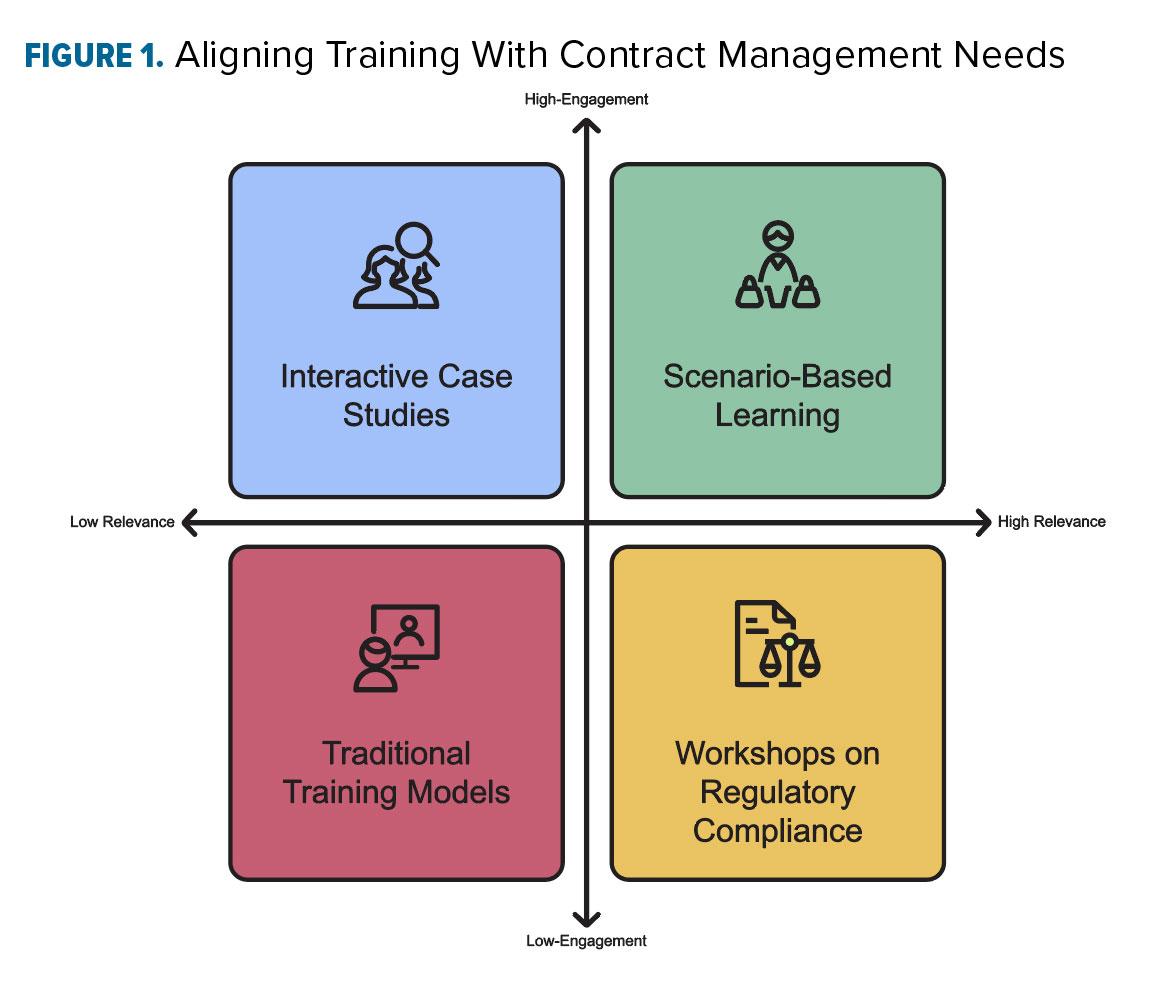
• Scenario-Based Learning: Using real-world procurement challenges to teach risk identification and mitigation. These scenarios can be tailored to the needs of individuals and teams to ensure the best possible outcomes.
• Workshops on Regulatory Compliance: Covering new and emerging provisions in federal procurement laws, policies and regulations. This component has taken on outsized importance in 2025. Joining teams dedicated to government contracting on sites like LinkedIn are a good starting point. Following NCMA’s live learning catalog is another way to get the most current information for the workforce.
• Interactive Case Studies: Examining past procurement failures and successes to highlight risk management best practices. Maintain an after-action review library and share both your successes and areas for improvement within the community. Learning from someone else’s pain is always better than from your own.
Figure 1 identifies how to view these types of programs as well as more traditional training initiatives. It shows a continuum of engagement versus relevance. When used properly this matrix can show leaders how to invest their limited resources for the most mission-focused outcomes.
Keeping Pace with Regulatory Changes
This is a year of unprecedented change in the world of U.S. government acquisition. The administration’s desire to “unleash prosperity through deregulation,” as articulated in Executive Order 14192, is driving massive changes within the regulatory landscape. Being able to keep up with the impending changes to the Federal Acquisition Regulations (FAR) and agency supplements will be critical to the proper execution of contract actions.
Organizations must ensure that contract professionals are well-versed in these changes through structured training programs. Live webinars, on-demand courses, and scenario-based exercises help contract managers navigate policy updates without disrupting operational workflows. Encourage knowledge-sharing initiatives between government agencies and industry partners to align procurement practices with evolving regulations. Develop joint training programs to ensure consistency in the interpretation and application of regulations.
Case Study: The U.S. Army’s Skills Gap Analysis
In her book “Data-Driven Talent Management: Using Analytics to Improve Employee Experience,” Kris Saling writes extensively about the Army’s use of data to improve workforce development initiatives. The U.S. Army has pioneered a proactive approach to these activities through comprehensive skills gap analyses using data-driven skill development.
Organizations are now leveraging data analytics to refine their training methodologies. Competency frameworks allow acquisition teams to assess critical skills – ranging from negotiation techniques to risk assessment strategies and emerging tools like generative AI. (2)
When we established the acquisition workforce development program at HRC, it was with the intent of fostering meaningful change within the command. We were fortunate that for almost five years we had the unwavering support of our senior leaders. Our goal was to foster a culture of continuous learning among acquisition professionals by utilizing performance standards tied to awarded Continuous Learning Points (CLPs).
We set clear expectations and aligned CLPs with mission-driven competencies. We wanted to ensure that professional development remained relevant, rigorous, and responsive to the evolving needs of the command. By establishing measurable benchmarks for learning outcomes, we not only encouraged individuals to engage in meaningful education but also reinforced the importance of skill enhancement in the acquisition process.
Through structured guidance, mentorship, and accountability, we encouraged and empowered our professionals to take ownership of their growth. We drove operational excellence and innovation across the organization. Ultimately, this approach ensured that acquisition personnel remained highly skilled, adaptive, and ready to support the command’s objectives with precision and expertise.
We were able to identify competency shortages across our acquisition teams, and work with the workforce to individually tailor training programs to address specific needs. This model underscores the importance of aligning training with evolving contract management challenges, ensuring workforce needs are addressed in a manner that addresses the needs of both the individual and the command. This approach truly created a win/win scenario.
The Army employs data-driven skills assessments to identify gaps in critical areas. The true beauty of such an approach is that it can be tailored to the needs of the command and address shortfalls in common areas such as regulatory compliance (e.g., FAR updates), risk assessment and mitigation strategies, procurement negotiation techniques, and emerging technologies, including AI-driven contract automation. These areas become even more critical with the impending changes to the FAR and the impact those changes will have on processes within our community.
Defining Critical Competencies
We attempted to define our approach using competency frameworks. These frameworks provide structured insights into the core capabilities required for effective contract management. Key areas include:
• Advanced negotiation tactics for procurement professionals – Professionals trained in advanced tactics can leverage supplier dynamics, cost analysis, and cooperative problem-solving to achieve favorable contract terms and strengthen long-term partner-ships.
• Risk assessment methodologies that align with federal compliance standards – By utilizing structured frameworks, such as quantitative risk assessment and mitigation planning, professionals can identify potential contract vulnerabilities, minimize exposure to fraud or mismanagement, and safeguard government interests.
• The use of AI-powered contract automation tools for efficiency gains – Acquisition professionals equipped with AI tools can enhance data accuracy, expedite procurement timelines, and reduce administrative burden, improving overall operational efficiency.
• Navigating CSO (Commercial Solutions Opening) and OT (Other Transaction) authorities – Understanding these authorities enables professionals to structure agreements that foster collaboration with non-traditional vendors while maintaining transparency and accountability in procurement practices.
• Streamlined procurement methods – Modernizing procurement workflows through agile methodologies, category management, and strategic sourcing enables acquisition professionals to reduce costs and improve efficiency.
On-demand access to contract law updates empowers professionals to stay ahead of regulatory shifts. AI-driven recommendation engines personalize learning pathways based on individual competency gaps.
Measuring Training ROI
As acquisition professionals, we serve as business-focused leaders within our organizations. Any program we advocate must demonstrate a return on investment and workforce development programs are no different. To justify investments in training programs, organizations must track measurable outcomes. Some key performance indicators include:
• Reduced error rates in contract documentation – Training helps acquisition professionals develop a stronger understanding of regulatory requirements, compliance standards, and best practices, leading to fewer inaccuracies in contract paperwork. Lower error rates result in smoother audits, reduced financial penalties, and enhanced operational credibility.
• Faster contract cycle times – Well-trained personnel can streamline procurement processes by applying industry best practices and leveraging technology effectively. Training programs that emphasize efficiency tactics such as automated workflows and data-driven decision-making enable faster turnaround times from contract initiation to execution, minimizing delays and in-creasing mission readiness.
• Increased workforce retention and satisfaction – Investing in employee development fosters a culture of continuous learning and professional growth, boosting engagement and morale.
This list is not exhaustive, but by integrating metrics like these into talent development initiatives, agencies can optimize their work-force strategies.
Empowerment
Beyond technical training, successful contract management requires empowerment, allowing professionals to take ownership of their roles and contribute to innovation. Organizational structures must define a clear decision space that facilitates autonomy while maintaining accountability, ensuring individuals can make informed choices within established boundaries. One way to accomplish this is through the adoption of tiered approval thresholds.
When properly constructed, these risk-based tools can accelerate procurement cycles without compromising oversight. Collaborative platforms enable acquisition teams to streamline workflows while maintaining compliance. By leveraging digital tools, contract managers can make data-driven decisions without excessive bureaucratic bottlenecks.
Empowerment, as described here, requires a belief that employees want to do the right thing. You must believe that no employee wants to perform poorly and, as a leader, you have to be willing to underwrite honest mistakes. All too often that philosophy is reduced to being a buzzword, but it has to be more than a bumper sticker.
You can change your organizational structure to support tiered approvals, and you can provide all the digital tools in the world, but if there is no level of trust established it will be meaningless. Empowerment requires trust in your hiring process.
Trust that you have correctly selected and trained the right person for the right job. If those things are true, if you have trust in the people and processes within your team, then why wouldn’t you empower them to do the things you have hired them for? As Steve Jobs is often quoted as saying, “It makes no sense to hire smart people and tell them what to do.”
Empowerment and decision space go hand in hand, shaping how individuals take ownership of their choices and influence outcomes. When leaders expand the decision space, giving professionals more autonomy and flexibility, they foster a culture of trust and innovation. Empowered individuals can make informed decisions with confidence, knowing they have the authority and resources to act within a well-defined framework.
Once a team has been empowered, it begins to feel valued. That value gives individual contributions meaning. That meaning contributes to higher retention. Higher retention leads to increased efficiency. Increased efficiency leads to improved employee satisfaction and retention.
Retention
We have already looked into training and empowerment. Now let’s explore the final of the three interconnected pillars, retention.
We would be remiss to discuss retention without acknowledging the challenges posed by ongoing workforce cuts and shorts. Teams are being asked to do more with less, making it more critical than ever to retain the right people.
A fully successful retention program should be informed by data, supported by education and development, and lead to the continued employment of the right individuals with the correct mindset and skills to benefit the organization.
Organizations can now track career progression using data-driven dashboards. These tools provide workforce insights, helping man-agers identify strengths, predict attrition risks, and tailor employee development strategies.
To sustain retention of quality individuals, agencies must establish a culture of continuous learning. This requires a blend of structured programs and self-directed initiatives. Structured programs should go beyond symbolic gestures, aligning with professional development pathways. This includes:
• Certification programs that validate specialized skills – A well-designed certification program should be flexible and tailored to the diverse roles and expertise levels within the acquisition workforce. Instead of a rigid, one-size-fits-all approach, agencies should offer a range of certification pathways that align with individual career goals, functional specialties, and evolving industry demands.
• Leadership opportunities for emerging talent – rotational leadership assignments, executive coaching, and shadowing senior personnel allow rising professionals to develop critical decision-making and strategic thinking skills essential for guiding acquisition efforts effectively.
• Cross-functional mentorship initiatives to foster knowledge exchange – Partnering with other federal agencies, such as the Department of Defense, General Services Administration, and Small Business Administration, enables acquisition professionals to learn from different regulatory frameworks, contract management approaches, and procurement strategies.
• Technology and innovation labs – Establishing partnerships with industry research teams and federal innovation offices enables acquisition professionals to explore AI-driven contract automation tools, cybersecurity protocols, and advanced analytics that enhance decision-making.
Such programs should not be an afterthought; instead, they should start with effective internship programs that serve as talent pipe-lines, introducing aspiring contract professionals to real-world challenges. Structured rotations, mentorship opportunities, and out-come-based assessments ensure long-term workforce continuity.
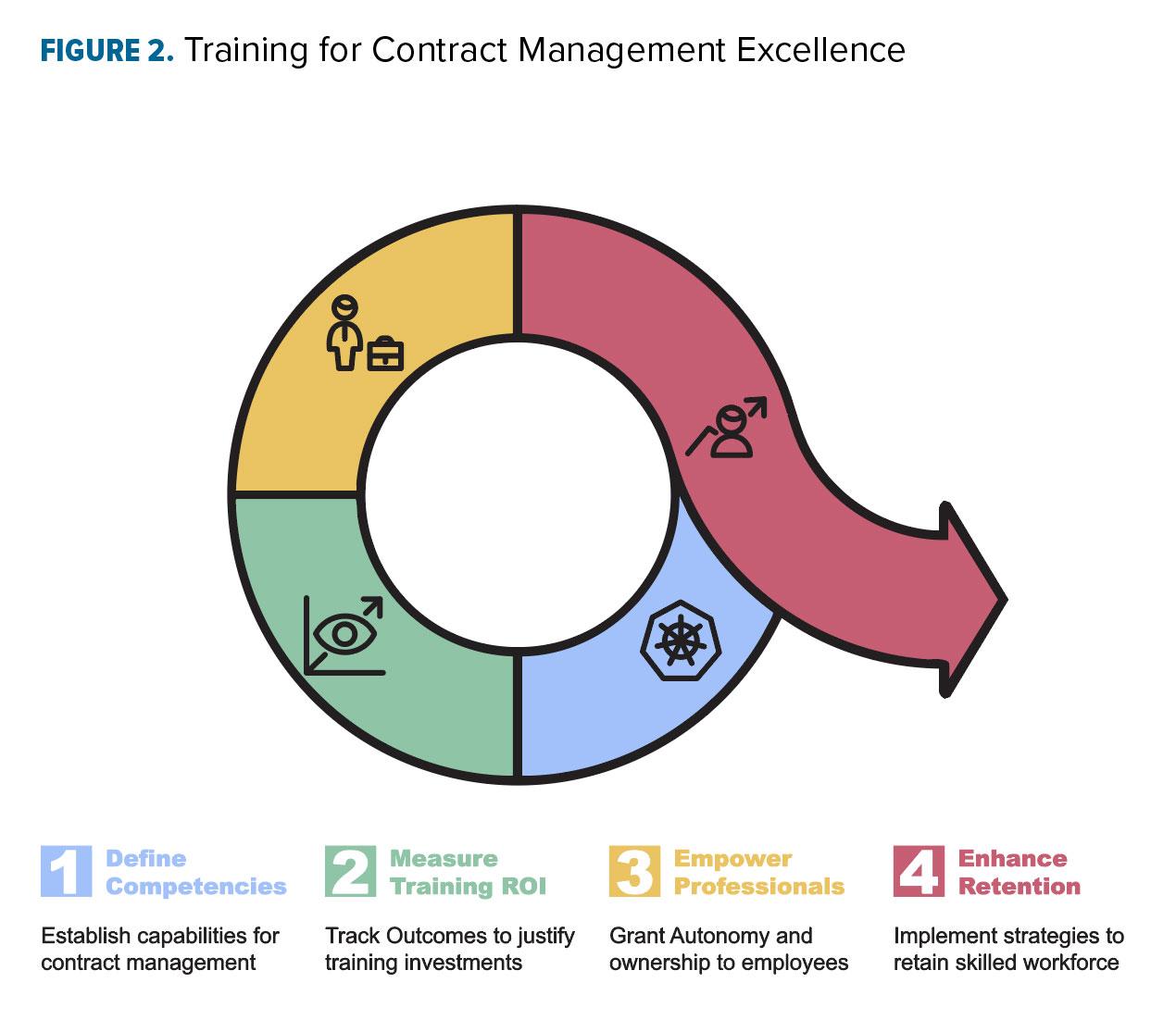
Talent development does not exist in isolation. Training fosters competency, empowerment drives engagement, and retention ensures continuity – creating a self-reinforcing cycle that strengthens contract management excellence. Retention can be bolstered using cross functional training programs that allow team members to explore exactly how their contributions fit into the larger picture. Such partnerships between government agencies facilitate knowledge sharing, fostering a unified approach to contract compliance. Collaborative training programs also enhance industry-government alignment, ensuring the adoption of best practices across various sectors.
Final Takeaway: Leadership Commitment to Workforce Development
Talent management is not solely an HR function; it requires a cross-functional commitment from leadership. Contracting officers, acquisition specialists, and policy leaders must collaboratively champion workforce development to drive sustainable impact.
Leaders within the contracting community must prioritize a defined process of training and development to achieve true excellence in our craft. Figure 2 illustrates a conceptual approach to this cycle, but it is intended only as a starting point.
As contract management continues to evolve, organizations must prioritize talent as a strategic initiative. By integrating training, empowerment, and analytics-driven retention strategies, agencies can future-proof their workforces while maintaining compliance and fostering innovation. CM
Patty Houchin is a seasoned acquisition professional with 15 years of experience in federal government contracting. Passionate about acquisition training and professional development, she is dedicated to empowering professionals with the knowledge and skills needed to navigate the complexities of procurement and contracting.
Mike Carroll, MBA is the former Director of Acquisition and Procurement at the U.S. Army Human Resources Command and currently supports the Department of State’s Coordinator for Afghan Relocation Efforts (CARE) as a contract employee serving in the role of Senior Acquisition Program Manager.
ENDNOTES
1 (Levinson, 1992)
2 (Saling, 2024)